
Trading Futures vs CFD: Why Pro Traders Are Migrating to CME Prop Firms
The retail trading industry is experiencing a seismic shift. Thousands of profitable Forex and CFD traders are abandoning MetaTrader platforms and migrating to CME-regulated futures prop firms—and the reason is brutally simple: they are tired of being sabotaged by their own brokers.
If you have ever experienced unexplained slippage during NFP releases, watched your stop loss get hunted by 2 pips before the price reverses exactly as you predicted, or had a withdrawal request denied after weeks of profitable trading due to "violation of terms," you already know the game is rigged. CFD brokers operate B-Book models where your loss is literally their profit, creating an inherent conflict of interest that no amount of marketing can disguise.
Futures prop firms offer something CFD traders have never experienced: direct market access to the Chicago Mercantile Exchange (CME). Here, your orders hit real institutional order flow, execute at exchange-regulated prices, and generate transparent commissions instead of being traded against. This comprehensive guide decodes the entire migration path—from understanding tick values and EOD drawdown rules to selecting professional platforms that display Level 2 data. If you are ready to trade in a real market where your edge actually matters, this is your complete roadmap.
Zero broker intervention. Real order book.
Standardized, exchange-set, non-negotiable.
Firms profit from your volume, not losses.
Updates at 5 PM ET. Intraday peaks don't punish you.

What is a Futures Prop Firm? (The End of B-Book Manipulation)
Direct Answer: A futures prop firm is a proprietary trading company that funds traders to trade standardized contracts on regulated, centralized exchanges such as the CME Group. Unlike CFD/Forex prop firms—which route orders through a broker acting as a market maker (B-Book model)—futures prop firms provide genuine Direct Market Access (DMA). Traders interact with the live order book, and the firm profits from a share of trader-generated profits and commissions, not from trader losses.
Direct Market Access vs. Market Makers: The Structural Conflict
The fundamental distinction between futures and CFD trading lies in market structure. When you trade a CFD on EUR/USD through a MetaTrader broker, you are not participating in the actual interbank Forex market. You are entering a bilateral contract with your broker, who acts as the counterparty to your position.
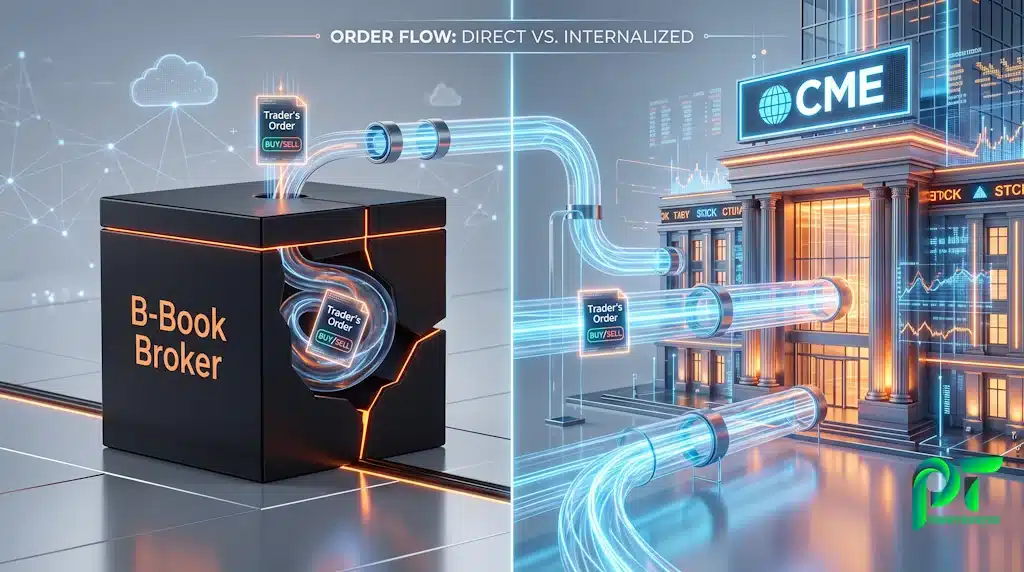
This is the B-Book model. The broker can see your stop loss orders, your position size, and your entry price in real-time through their dealing desk software. They have a direct financial incentive to trigger your stops, widen spreads during news events, and deny your withdrawal. The CFTC banned CFDs in the United States precisely to protect retail investors from these predatory practices.
Futures prop firms eliminate this conflict entirely through Direct Market Access (DMA). When you submit a buy order for one E-mini S&P 500 contract (ES), your order is routed through a Futures Commission Merchant (FCM) directly to the CME Globex matching engine. The exchange pairs your buy order with a sell order from another market participant. The CME provides full market depth transparency through Level 2 data (DOM), showing all resting limit orders at each price level. This order book data is identical for retail traders and Wall Street institutions.
The Futures Trading Language: Decoding Contracts, Ticks & Points
Migrating from CFDs to futures requires learning a new vocabulary. The terminology shift reflects the underlying difference between standardized contracts and exchange-standardized derivatives.
Contracts vs. Lots (Understanding E-mini & Micros)
In Forex/CFD trading, position size is measured in lots (standard, mini, micro). Position sizing is infinitely flexible, and fractional leverage allows positions far exceeding account size.
Futures contracts are standardized, indivisible instruments defined by the exchange. One E-mini S&P 500 (ES) contract represents $50 multiplied by the index value. You cannot trade 0.5 ES contracts—it's either one full contract or zero. To accommodate smaller retail accounts, the CME introduced Micro contracts:
- E-mini S&P 500 (ES): $50 multiplier per point.
- Micro E-mini S&P 500 (MES): $5 multiplier per point (1/10th the size of ES).
Micro contracts (MES, MNQ) democratized futures trading. They allow traders to scale into positions safely, making professional futures trading accessible to accounts as small as a $25,000 funded balance.
Ticks & Points vs. Pips
Forex CFD traders measure price movement in pips. Futures use ticks and points:
- Tick: The minimum price fluctuation allowed by the exchange for a specific contract.
- Point: A whole number move in the contract price (equal to 4 ticks in the ES and MES).
A CFD trader accustomed to flexible lot sizing might incorrectly assume they can "risk $500" by opening 5 ES contracts without calculating the tick risk. If the trade moves just 2 points (8 ticks) against them, the loss becomes $500 immediately. Professional futures traders think strictly in tick risk and R-multiples.
CFD vs Futures Prop Firms: The Ultimate Comparison Matrix
| Feature | CFD/Forex Prop Firms | CME Futures Prop Firms |
|---|---|---|
| Execution Model | B-Book / Market Maker (Conflict of Interest). | Direct Market Access (CME Globex). No dealing desk. |
| Pricing & Transparency | Synthetic prices; broker hides real order book. | Centralized pricing; full Level 2 (DOM) order book visible. |
| Slippage | Artificial & broker-controlled (widening spreads). | Genuine market mechanics; based on exact order book liquidity. |
| Platforms | MetaTrader 4/5, cTrader (No order flow tools). | NinjaTrader, Tradovate, Quantower (Footprint, Level 2 native). |
| Drawdown Model | Intraday Trailing (Tick-by-tick peak equity tracking). | End-of-Day (EOD) Drawdown (Calculated only at 5 PM ET close). |
| Leverage & Margin | Broker-set; up to 1:100+ (Encourages gambling). | Exchange-set Initial/Maintenance margins (Protects capital). |
| Regulatory Oversight | Offshore (Cyprus, Seychelles, Vanuatu). | CFTC and NFA regulated (Strict US oversight). |
Decoding Futures Prop Firm Rules (How to Keep Your Funded Account)
This is where the majority of migrating traders fail. Not because their strategy stops working, but because they apply CFD-era risk management logic to a futures rule environment.
End of Day (EOD) Drawdown vs. Intraday Trailing
Understanding drawdown model mechanics is the single highest-leverage knowledge investment a funded futures trader can make.
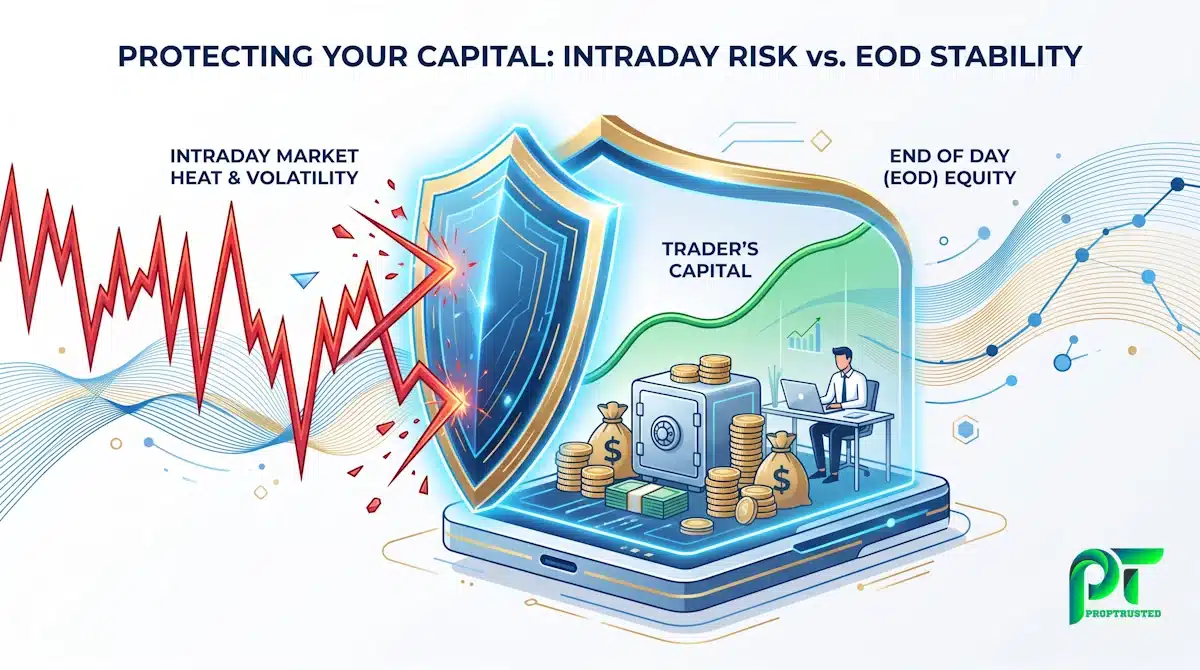
Intraday Trailing Drawdown (The CFD Trap): Your max loss limit follows your live equity tick-by-tick, including unrealized profits. If you have an open winning trade that temporarily reaches +$2,000, your drawdown floor immediately rises by $2,000. If that trade pulls back and you close at +$200, you have permanently lost $1,800 of your drawdown cushion.
End-of-Day (EOD) Drawdown (The Professional Standard): EOD drawdown updates only at the close of the trading session (typically 5 PM ET). Intraday peaks don't matter; only the closing balance does. A trader can scalp aggressively, hit +$3,000 unrealized, give back $1,500, and close at +$1,500—and the drawdown only moves based on the $1,500 closing balance.
The Scaling Ladder & Contract Limits
Futures prop firms enforce progressive maximum contract limits. A common progression for a $50K account is starting with a maximum of 5 Micro contracts (MES/MNQ) and gradually unlocking E-mini (ES) contracts as cumulative profits grow. This prevents novice traders from over-leveraging into catastrophic losses and ensures disciplined growth—the exact opposite of CFD firms that offer 1:100 leverage on day one to accelerate account blow-ups.
Platform Wars: MetaTrader vs. Tradovate, NinjaTrader & Quantower
MetaTrader 4/5 is architecturally incompatible with the futures prop ecosystem. It was built for synthetic pricing and lacks the tools required for institutional order flow analysis.
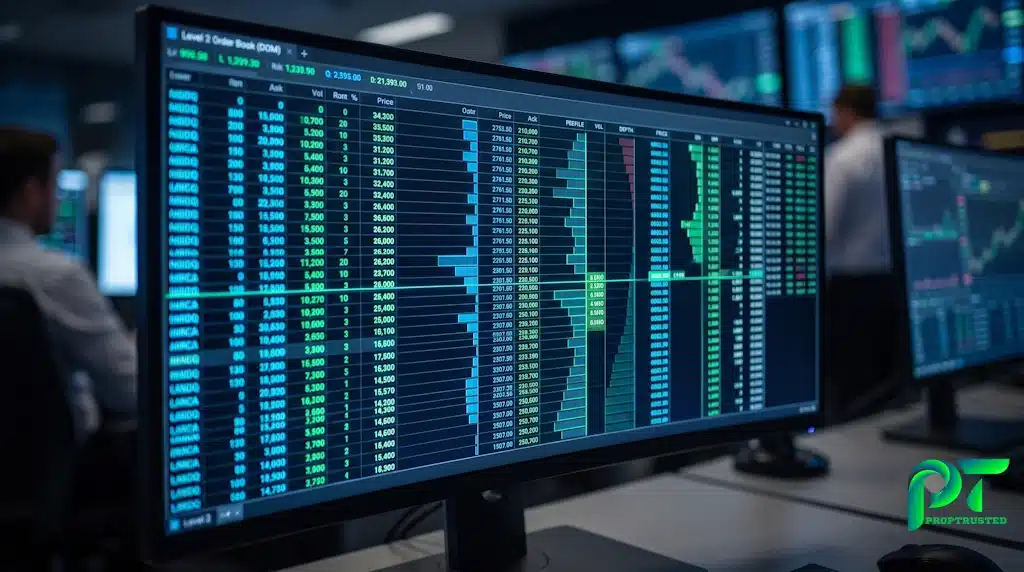
- NinjaTrader 8: The professional benchmark. Offers SuperDOM (point-and-click order entry), Footprint charts, and advanced C# algorithmic capabilities. Ideal for serious discretionary and order flow traders.
- Tradovate: The cloud-first solution. Runs directly in your browser or Mac with zero installation. Perfect for traders migrating from MetaTrader who want a lower-friction onboarding experience with solid DOM features.
- Quantower: The order flow specialist. Features the most advanced footprint rendering, DOM Surface heatmaps, and Volume Profile in the industry. The ultimate weapon for reading institutional flow.
In CFD trading, there is no Level 2 data. In CME futures, Level 2 data shows you the exact quantity of resting buy and sell orders at every price level in real time. This is access to a categorically different class of market intelligence.
Final Verdict: Which Prop Firm Model is Right for You?
- You are a Scalper, DOM Trader, or Order Flow analyst.
- You are tired of B-Book manipulation, artificial slippage, and payout denials.
- You trade US equity indices (ES, NQ), commodities, or rates.
- You want strict regulatory protection (CFTC/NFA) and a professional EOD drawdown environment.
- You trade exclusively exotic Forex pairs that lack liquid futures equivalents.
- You swing trade multi-day positions and cannot manage futures contract rollovers.
- Your net profitability is not yet high enough to absorb the fixed data and platform fees.
Frequently Asked Questions
Can I use my MetaTrader strategy directly on a CME Futures prop firm account?
Not without significant modification. MetaTrader Expert Advisors (EAs) use MQL4/MQL5 and cannot interface with CME Globex. Beyond code, your strategy's core logic must be recalibrated: tick values, exact exchange margins, and whole-contract position sizing operate differently than variable Forex lot sizing.
What is the biggest mistake traders make when migrating from CFD to Futures?
Misunderstanding drawdown mechanics and tick value risk. Traders accustomed to arbitrary CFD leverage often oversize their futures positions without calculating the exact dollar risk per tick. Furthermore, failing to understand how EOD drawdown provides an advantage over Intraday Trailing leads to poor trade management.
How does EOD drawdown interact with overnight positions?
Futures "end of day" is typically 5 PM ET (CME close). If you hold a position through the 5 PM settlement, the closing balance (including unrealized P&L) becomes the reference point for the new drawdown calculation. Unless explicitly permitted by your firm, the professional standard is to close all positions by 4:45 PM ET to avoid margin violations.
Are futures prop firm profits subject to different tax treatments?
Yes. In the US, broad-based index futures (like ES and NQ) fall under Section 1256, meaning profits receive a highly favorable 60/40 tax treatment (60% long-term capital gains, 40% short-term), regardless of how long the trade was held. CFDs do not qualify for this and are generally taxed entirely as ordinary income. Always taxed as standard income formats globally. Always consult a tax professional.