

Prop Firm Rules Explained: The Ultimate Guide to CFD Trading & Drawdown Types (2026)
Why risk your own hard-earned $1,000 when top-tier prop firms are ready to allocate $100,000 — or more — directly to your trading arsenal?
The prop trading industry has exploded into a multi-billion-dollar machine, and retail traders across the globe are leveraging it to access institutional-grade capital without putting a single dollar of personal savings on the line. But here's the brutal truth that most retail traders discover too late: The prop firm industry speaks a deliberately complex language designed to filter out unprepared traders. Words like "balance-based drawdown," "equity trailing," and "consistency algorithms" aren't just technical jargon—they are legal tripwires that can invalidate your entire account overnight.
Prop firm drawdown is the #1 reason funded traders lose their accounts. Most traders don't fail because of a bad strategy or market conditions; they fail because they don't fully understand how drawdown rules work until it's too late. This comprehensive guide is your insider's decoder.

What is a Proprietary Trading Firm? (The Business Model)
A proprietary trading firm (prop firm) is a financial institution that provides qualified traders with capital to trade CFD markets (Forex, indices, commodities) in exchange for a profit split, typically 70-90% to the trader. Traders risk no personal capital beyond an affordable evaluation fee, gaining access to accounts ranging from $10,000 to $2,000,000.
The Capital Allocation Revolution
Proprietary trading firms have fundamentally restructured retail trading by solving the industry's oldest problem: capital scarcity. Unlike traditional retail trading where your account size directly limits your earning potential, prop firms operate on a capital allocation model that separates trading skill from personal wealth.
Here is how the business architecture works: Prop firms generate revenue through evaluation fees (typically $50-$1,000 depending on account size) that traders pay to demonstrate consistent profitability under specific rule sets. These evaluations serve as sophisticated filtering mechanisms, identifying traders who can manage risk, maintain consistency, and generate returns without catastrophic drawdowns.
Once you successfully navigate the evaluation phase, the firm allocates live (or simulated with guaranteed payouts) capital to your trading operations. A skilled trader with only $500 in personal savings can access a $100,000 trading account, potentially earning $8,000 from a 10% monthly return ($10,000 profit × 80% split). This represents a massive leverage on earning potential, not through risky position sizing, but through institutional capital access.
What is CFD Prop Trading?
Before diving into the rulebook, every trader must understand exactly what instrument they are trading inside a prop firm account. The answer, for the vast majority of firms, is a Contract for Difference (CFD).
A CFD is a derivative instrument—a financial contract between you and the broker that pays the difference in the price of an underlying asset between when the contract is opened and when it is closed. Crucially, you never take ownership of the underlying asset itself. You are speculating purely on price movement, up or down.
Leverage and The CFD Asset Universe
CFD trading's most distinctive characteristic is embedded leverage, allowing traders to control large position sizes with relatively small capital deposits. Prop firms typically offer leverage ratios between 1:10 and 1:100. Prop firm traders typically access major CFD categories:
- Forex Pairs: EUR/USD, GBP/JPY, AUD/CAD. The most liquid instruments offering 24-hour trading across global sessions.
- Indices: S&P 500, NASDAQ 100, DAX 40. Equity index CFDs track major stock market benchmarks.
- Commodities: Gold (XAUUSD), Silver, Crude Oil. Gold is a powerhouse of opportunity due to its strong trending characteristics.
- Cryptocurrencies: Bitcoin, Ethereum (offered by select progressive prop firms).
While leverage amplifies your profit potential, it is a double-edged sword. Inside a prop account, it amplifies the speed at which drawdown limits can be reached. A single overleveraged trade during a news spike can wipe out an entire account's daily buffer in seconds.
The Ultimate Prop Firm Rules Dictionary
Navigating proprietary firm evaluations requires fluency in a specialized vocabulary designed to quantify risk management and professional trading behavior.
1. Daily Drawdown (Daily Loss Limit) Explained
Daily Drawdown represents the maximum permissible loss within a single trading day before automatic account termination. This rule functions as your most immediate constraint, resetting at a specific time (usually midnight server time or 5:00 PM EST).
Most prop firms calculate daily drawdown using one of two methods:
- Start-of-Day Balance Baseline: Your daily loss limit is calculated from your account balance at the day's beginning. If you have a $100,000 account with a 5% limit, your maximum permissible account value is $95,000. If your equity touches $94,999 at ANY point, you violate the rule.
- Previous Day's End-of-Day Balance: More trader-friendly firms calculate from the previous day's official close balance. If you closed yesterday at $102,000, your 5% limit gives you a $5,100 buffer for today.
Critical Note: Floating losses count immediately. If you are holding open positions showing an unrealized loss that pushes your equity below the daily limit, your account is terminated instantly.
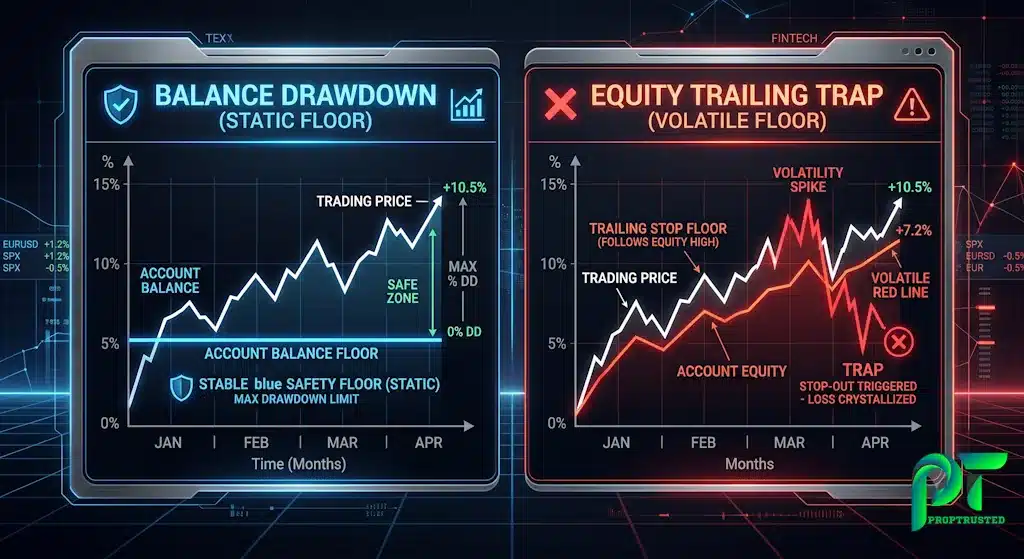
2. Balance vs. Equity Drawdown: The Crucial Difference
This single distinction represents the most misunderstood and most frequently violated rule in proprietary trading.
| Feature | Balance Drawdown | Equity Drawdown (Trailing) |
|---|---|---|
| Calculation Basis | Closed trades only | Closed + open (floating) P&L |
| Floor Movement | Static — never moves from initial balance | Dynamic — adjusts upward with profits |
| Floating Profit Impact | Does NOT raise the failure floor | Raises the floor (The Equity Trap) |
| Best Suited For | Swing traders, position traders | Strict intraday scalpers |
The Trailing Equity Trap
Equity-based drawdown tracks your real-time account value, including all floating profits and losses. The most dangerous variant is trailing equity-based drawdown, which adjusts your violation threshold upward as you make profits, but never downward when you take losses.
If you start with $100,000 and a 10% trailing limit, your floor is $90,000. If you earn $6,000, your balance is $106,000, and your new floor permanently locks in at $96,000. The psychological cruelty of trailing equity systems is that your own success tightens the noose. The better you perform initially, the higher your violation floor rises, leaving you less room for normal drawdown volatility later.
3. The Consistency Rule (Why Firms Hate Lucky Lot Sizes)

Proprietary trading firms want consistent, repeatable, low-volatility profit generators. The consistency rule exists to filter out lottery-ticket traders who pass evaluations through luck.
Most consistency rules stipulate that no single trading day can represent more than 30-50% of your total profit during the evaluation period. If your target is $10,000 and your consistency threshold is 40%, your maximum allowable profit from a single day is $4,000. If you make $9,500 on one massive news trade, you will fail the evaluation—even if you hit your overall target.
Firms enforce this because traders who pass via one massive winner overwhelmingly fail in live funded accounts. The rule forces deliberate risk management and builds the exact habit patterns that create career longevity.
4. The Inactivity Rule (Maximum Days Without Placing a Trade)
The inactivity rule mandates that traders must execute at least one trade within a specified period, typically ranging from 30 to 90 days depending on the firm. Prop firms implement this to ensure allocated risk capital doesn't sit unproductive and to verify ongoing trader competence. If you anticipate being unable to trade, proactively contact your prop firm's support team to request an account freeze.
5. Prop Firm Scaling Plans (Account Growth Rules)

Scaling plans represent the career progression pathway within prop firms—the systematic process by which consistent performers access exponentially larger capital allocations.
- Initial Funded Account: $10,000 - $100,000 based on the evaluation purchased.
- First Scale-Up: Achieve a ~10% return over 3-4 consecutive profitable months, and firms typically offer scaling to $150,000 or $200,000.
- Progressive Scaling: Top performers can reach 4-8x their initial allocation over 12-24 months. Elite traders can access up to $2,000,000+ allocations.
Ready to Scale with FundedNext?
Access one of the industry's most reliable payout infrastructures and scale up to $4M.
Frequently Asked Questions (FAQs)
What happens to my profit split if I violate a rule during a funded phase?
Rule violations during funded phases result in immediate account termination with zero tolerance. Your trading platform credentials are disabled, any undrawn profits are forfeited, and you must purchase a new evaluation from scratch to regain funding.
Can a floating (unrealized) loss breach my drawdown limit?
Yes. In an equity-based drawdown system, floating losses count immediately against your limit. If your closed balance is safe but a currently open trade pushes your live equity below the threshold, your account is breached instantly.
Can I trade the same prop firm evaluation on multiple accounts simultaneously?
While technically possible at some firms, it dramatically increases your costs without proportionally improving your success probability. It is mathematically and strategically better to master the evaluation process with a single account first. Furthermore, some firms explicitly ban copy-trading between your own accounts.
Do prop firms actually trade my positions in real markets once I'm funded?
The majority of prop firms operate funded accounts on simulation platforms (B-Book) and pay successful traders from the pool of evaluation fees. A smaller minority selectively copy successful traders' positions into real markets (A-Book). Operationally, it doesn't matter as long as the firm consistently pays its traders.
Is equity-based or balance-based drawdown better for my trading style?
Balance-based drawdown is vastly superior for swing traders and position traders, as floating losses do not permanently impact the drawdown limit until closed. Equity-based (and especially trailing equity) drawdown is extremely restrictive and only suitable for strict intraday scalpers who close all positions before the end of the session.
Can I use Expert Advisors (EAs) and automated trading systems?
Most major prop firms permit EAs, but with strict limitations. High-Frequency Trading (HFT), latency arbitrage, opposite hedging, and tick scalping are universally prohibited. If your EA exploits demo environment latency rather than displaying a genuine market edge, your account will eventually be flagged and banned.