
Best Futures Funded Trading Accounts in the USA (2026 Compliance Guide)
If you are a US-based retail trader who has been watching your favorite forex or CFD prop firm ban American clients, restrict MetaTrader access, or—worse—freeze accounts without warning, you are not alone, and your anxiety is entirely rational. Between early 2024 and late 2025, an estimated 100 prop firms ceased operations, representing a 14% contraction of the entire global prop trading market.
The regulatory squeeze is unprecedented: MetaQuotes imposed permanent geographical restrictions on US-based prop firms offering MT4/MT5 platforms, the CFTC intensified enforcement against offshore CFD brokers operating illegally within US borders, and dozens of popular platforms abruptly added the United States to their prop firm restricted countries list. For US traders, the message from the unregulated CFD world has become unmistakably clear: you are no longer welcome.
This is not a temporary regulatory hiccup; it is a permanent structural shift forcing serious traders toward US-regulated CME Futures prop firms—the only sustainable, legally compliant path forward.
Unlike synthetic CFD contracts executed on opaque B-Book infrastructure, exchange-traded futures contracts clear through the Chicago Mercantile Exchange with full CFTC oversight, transparent pricing, and institutional-grade execution.
This 2026 compliance guide provides the definitive, research-backed analysis of prop firms allowing US traders without regulatory risk. Whether you are searching for a NinjaTrader funded account, evaluating futures infrastructure, or determining which platforms accept traders from the USA with maximum capital allocation, this guide eliminates guesswork and provides the institutional-level intelligence you need to make the right decision.
Why Retail Traders are Migrating to US Futures Prop Firms
Search interest for the term "prop firm" grew by more than 5,500 percent globally from 2020 to 2025, with futures-related queries now significantly outpacing forex in the US. The migration to the best futures prop firms USA isn't about chasing higher leverage—it is a rational, structural migration driven by survival and regulatory safety.
The Death of Retail CFD Leverage in the United States
The Contract for Difference (CFD) model—once the darling of retail prop trading—has been systematically dismantled within US jurisdiction. The regulatory death blow came through multiple enforcement vectors. The CFTC expanded its interpretation of Section 2(c)(2)(C) of the Commodity Exchange Act, classifying most offshore CFD prop arrangements as illegal off-exchange retail commodity transactions.
The practical impact? Traders who built strategies around 50:1 leverage on currency pairs suddenly found their accounts frozen. Prop firms that claimed to offer "funded accounts" were revealed to be operating bucket shops—never actually hedging client positions on real markets, instead profiting from trader losses through B-Book execution models. The death of retail CFD leverage in the United States isn't a conspiracy—it is a documented regulatory reality with measurable financial casualties.
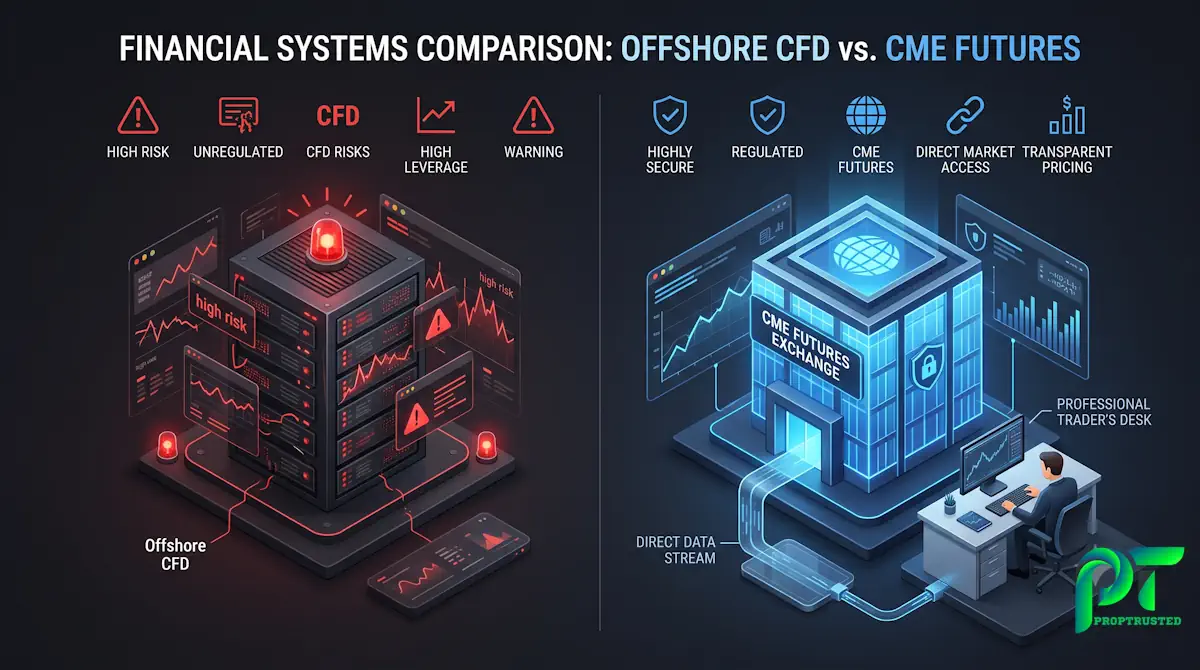
Exchange-Traded Contracts (CME) vs. Synthetic B-Book Execution
Understanding the fundamental difference between exchange-traded futures and synthetic CFD execution is critical for US traders evaluating risk exposure.
- Exchange-Traded Futures (CME Contracts): CME-cleared futures contracts represent legally binding agreements. When you trade ES (E-mini S&P 500) or NQ (E-mini Nasdaq) through a CFTC-regulated Futures Commission Merchant (FCM), every trade is centrally cleared through the CME Clearing House, price-discoverable via Level 2 market data, and timestamped on immutable exchange infrastructure.
- Synthetic CFD B-Book Execution: CFD "trading" through offshore prop firms operates on a fundamentally different model. There is no exchange transmission; your trade exists only on the prop firm's internal server. The firm sets its own bid/ask spreads, potentially widening them during volatile periods to trigger stop-losses.
Ultimate Comparison Matrix: Top US Futures Prop Firms 2026
Before committing capital to any of the best futures prop firms USA, understanding the key differentiation factors is essential. The evaluation fee alone does not determine value. Platform availability, drawdown calculations, and maximum allocation separate hobby-level prop firms from genuine career-building platforms.
| Prop Firm Name | Evaluation Fee (50K) | Maximum Allocation | Drawdown Type | Platforms | US-Based? | Current Discount |
|---|---|---|---|---|---|---|
| Top One Futures | ~$139/mo | $3,150,000 (scaled) | EOD Trailing | Tradovate, Quantower | ✅ Yes | Up to 60% OFF |
| DayTraders | See site | $4,500,000 (combined) | Intraday | NinjaTrader, Tradovate | ✅ Yes | Up to 50% OFF |
| E8 Futures | ~$148 | $4,000,000 (combined) | EOD Static / Trailing | Rithmic, NinjaTrader | ✅ Yes | 30% OFF |
| FundedNext Futures | $149 | $1,800,000 (combined) | EOD Trailing | Tradovate, Quantower | ❌ UAE | Special Pricing |
| Unbiased Alpha | $175 | $1,000,000 (combined) | EOD Static | NinjaTrader, Tradovate | ✅ Yes | 30% OFF |
Deep Dive: The 5 Best Futures Prop Firms Accepting US Clients
1. Top One Futures – Highest Allocation ($3.15M) & Maximum Discount (60% OFF)
Top One Futures has engineered the most aggressive capital scaling pathway available to US retail traders in 2026. While many prop firms cap funded allocations at $200,000, Top One Futures offers a documented path to $3.15 million in combined buying power through their progressive account scaling program.
Core Architecture & Why It Wins:
Operating a two-phase evaluation model (8% target phase 1, 5% phase 2), the firm utilizes an End-of-Day (EOD) trailing drawdown, which is a critical advantage giving traders intraday volatility tolerance. Traders can hold up to 3 simultaneous funded accounts, each scaling up to $1.05M based on performance milestones.
2. DayTraders – Direct US Architecture with Massive Buying Power ($4.5M & 50% OFF)
DayTraders operates the most US-centric institutional infrastructure in the prop firm space. With direct partnerships with US-regulated FCMs and a trader support team operating exclusively within US time zones, they eliminate jurisdictional ambiguity.
Core Architecture & Why It Wins:
Their headline differentiator is the $4.5 million maximum buying power (via aggregating 6 accounts at $750,000 each). They provide free NinjaTrader 8 licenses to all funded traders—a massive value-add for algorithmic traders requiring C# strategy deployment.
3. E8 Futures – The Institutional Anchor for American Traders (US Based, 30% OFF)
E8 Futures has established itself as the regulatory compliance benchmark. With a verifiable business entity registered in Delaware and over $47 million in verified trader payouts globally, E8 provides documented legitimacy for traders burned by offshore collapses.
Core Architecture & Why It Wins:
E8 implements a true End-of-Day (EOD) drawdown calculation assessed at 5:00 PM ET. This means you can experience significant intraday drawdown as long as your closed position equity at market close remains within parameters.
4. FundedNext Futures – Premier Global Infrastructure & Scale
FundedNext represents the global institutional standard adapted for US retail access. Processing over $127 million in cumulative payouts globally, they maintain Tier-1 banking relationships that ensure withdrawal reliability.
Core Architecture & Why It Wins:
FundedNext Futures offers an ironclad 24-hour payout guarantee—if they miss the window, they compensate you $1,000. They utilize an EOD trailing drawdown across three distinct evaluation tracks, allowing strategy alignment for different volatility profiles.
5. Unbiased Alpha – Transparent Rules for Precision Traders (US Based, 30% OFF)
Founded by former institutional quants, Unbiased Alpha explicitly targets data-driven, rule-following traders. Based in Texas, they publish monthly aggregated payout data and rule violation statistics, providing radical transparency.
Core Architecture & Why It Wins:
Unbiased Alpha utilizes a Static EOD Drawdown—the most forgiving model for volatile strategies because the drawdown floor never trails your profits. They enforce a tight 3% maximum daily loss, forcing strict risk management.
Hidden Rules to Inspect Before Buying a Futures Challenge
Beneath the headline numbers exist operational rules that fundamentally alter challenge difficulty. These are the variables that destroy accounts.
End-of-Day (EOD) Drawdown vs. Intraday Trailing Drawdown
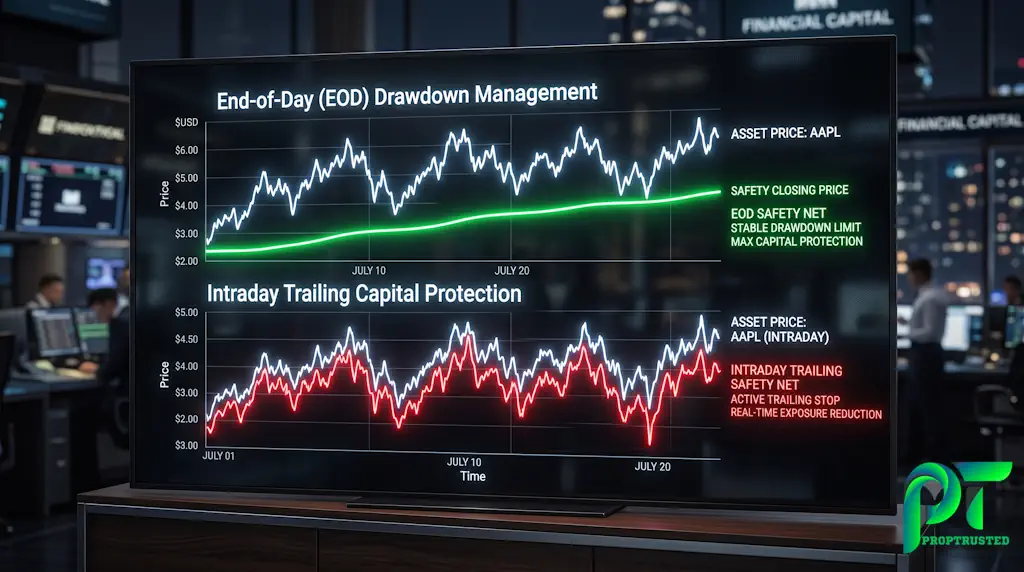
EOD Static/Trailing Drawdown is assessed once per day (typically 4:00-5:00 PM ET). Your closed positions' net P&L at that specific timestamp determines compliance. This allows you to experience adverse intraday volatility without violating rules, provided the trade recovers or is cut before the close.
Intraday Trailing Drawdown, conversely, tracks your peak account equity in real-time. Unrealized (open position) P&L counts toward peak detection. Always prioritize firms offering EOD drawdown.
CME Data Feed Fees and Platform Licensing Costs
The evaluation fee is not your only cost. As of 2026, CME classifies funded prop firm traders as Professional, meaning exchange data fees can escalate significantly.
- Data Fees: Ensure you know if the firm covers CME data (like E8 and Top One) or if you must pay out of pocket (which can cost $105+/month for the CME bundle).
- Platform Fees: NinjaTrader can cost $60/month to lease. Firms like DayTraders include it for free.
Lot Size Consistency and Scaling Ladder Constraints
Many firms enforce a consistency rule: your largest winning day cannot exceed 30% or 40% of your total profit. This prevents "hero trades" and lottery-ticket approaches. If you pass an evaluation with one massive CPI news trade, you will likely violate the consistency rule and fail.
Frequently Asked Questions (FAQ)
Are the best futures prop firms USA legal for US-based traders?
Yes, the best futures prop firms USA are entirely legal. Prop firms provide access exclusively to CFTC-regulated futures contracts traded on designated contract markets (CME). All trader positions clear through a CFTC-registered, NFA-member FCM. You operate as an independent contractor sharing profits, not a retail customer, fully insulating you from the regulations that shut down CFD brokers.
What is the tax treatment for US futures prop traders?
Most US futures prop firms classify traders as independent contractors and issue a Form 1099-NEC. The massive advantage is IRC Section 1256, which grants a 60/40 tax treatment (60% taxed as long-term capital gains, 40% as short-term), materially lowering your effective tax rate compared to standard ordinary income from forex or stocks.
What happens if I violate a rule during the funded phase?
It varies. Hard violations (hitting max drawdown) usually result in immediate termination. However, firms like E8 offer "violation forgiveness" for traders with long profitable histories, and Unbiased Alpha sells a "Violation Protection" add-on that acts as insurance, resetting your account once without penalty.
Can I run multiple prop firm accounts simultaneously?
Yes, multi-account trading is the primary scaling pathway. DayTraders allows up to 6 simultaneous accounts, while E8 allows 4. Most firms permit copying trades between your own accounts, but strict anti-hedging rules apply—you cannot go long on Account A and short on Account B to guarantee a risk-free payout.
What CME contracts can I trade?
You trade real CME-listed futures contracts: ES (S&P 500), NQ (Nasdaq), CL (Crude Oil), GC (Gold), and their Micro equivalents (MES, MNQ). Micro contracts are highly recommended during evaluations for precise risk control.
How do payouts work and how quickly can I get paid?
Once you request a payout, verification takes 24-48 hours. Firms headquartered in the US (like DayTraders, E8, Unbiased Alpha) offer rapid domestic ACH transfers. FundedNext offers a 24-hour processing guarantee.
*Disclaimer: This article is for informational and educational purposes only and does not constitute financial, investment, or legal advice. Futures trading involves substantial risk of loss and is not suitable for all investors. Always verify rules, fees, and promotions directly with the firm before purchasing.*