Trading NFP on a Prop Account: The SMC Guide to High-Impact News (2026)

"You didn't misread the direction. You traded a technically valid ICT concept into the single most mechanically hostile 60-second window in the financial markets. This guide fixes that execution gap."
The 11 Seconds That Ended the Challenge
8:29:58 AM EST. First Friday of the month. The Non-Farm Payrolls print is seconds away. You’ve spent four days positioning for this exact moment. The price action on EUR/USD telegraphed it perfectly: a massive liquidity pool built up below the Tuesday Asian session low. Smart money was loading.
At 8:29:59, you click market sell. The thesis is flawless. NFP prints stronger than expected (275K vs. 185K forecast). EUR/USD should plummet. The first 400 milliseconds of candle movement confirms it. You're immediately up 80 pips floating.
Then, the spread on your CFD broker's feed blows out to 47 pips.
Your 15-pip stop loss—structurally perfect and placed above a swept Daily high—gets triggered. Not because the market actually traded at that price, but because your broker’s ask price momentarily spiked through your stop due to artificial spread widening. A trade that was up $1,200 just closed at -$620.
This guide is your operational manual for surviving and profiting when you trade NFP prop firm accounts in 2026. No retail theories—just the exact execution protocols, risk parameters, and firm policies that determine whether you scale your capital or lose your funded status.
The NFP Trap: Why High-Impact News Destroys Prop Accounts
The retail narrative is simple: "Predict the number, trade the move." The institutional reality is much darker: NFP is a liquidity engineering event. The algorithms do not care about your economic forecast; they care about triggering the maximum number of retail stops to fill their own institutional orders at optimal prices.
When navigating high-impact news prop trading rules, three mechanical execution killers will destroy your account if you ignore them:
- Spread Widening: The moment the BLS releases the figure, liquidity providers pull their limit orders. That same spread routinely hits 20–50 pips on CFD platforms.
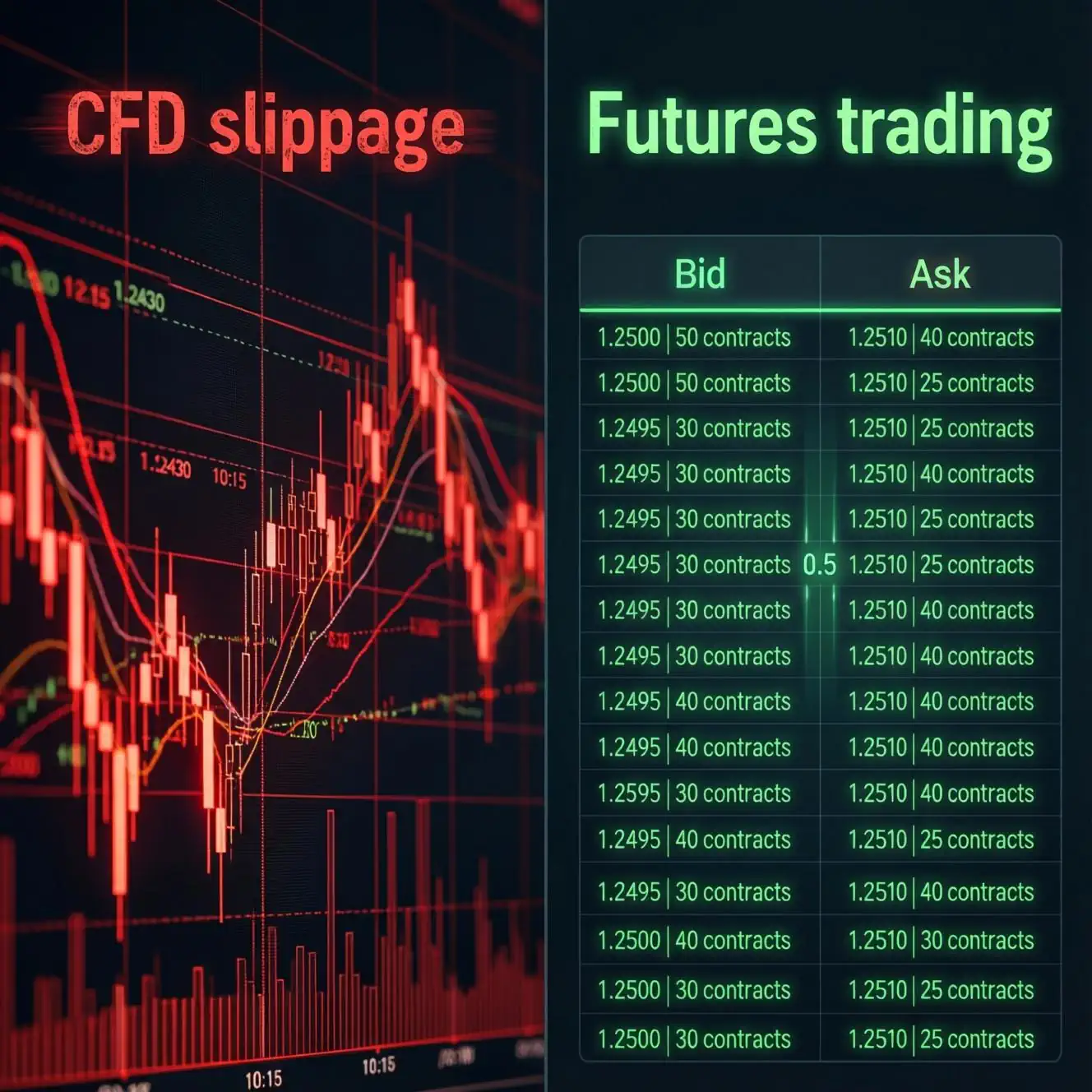
- Slippage Reality: Market orders during NFP do not get filled at your quoted price. Your hard stop fills at the next available bid or ask, which can be dramatically further away.
- CFD vs. Futures: CFDs suffer from discretionary spread markups. Futures trade on centralized order books (like CME) where slippage is bounded by visible depth.
The SMC News Trading Blueprint
Here is the absolute golden rule for trading NFP: Smart money does not trade the release minute. Smart money engineers the release minute—and trades the aftermath.

Phase 1 & 2: Post-Release Mitigation Entry
This is the core of a high-probability ICT NFP strategy. You never trade the first 60 seconds.
- 0–60 Seconds Post-Release: Price moves violently to sweep pre-marked liquidity pools. Spreads are at maximum width. You watch.
- 1–3 Minutes Post-Release: Volatility subsides and the spread normalizes.
- Mitigation Identification: Look for a powerful displacement candle that created a new Fair Value Gap (FVG) or Order Block (OB).
- The Execution: As price retraces to mitigate that FVG, you enter with a Limit Order. Stop goes beyond the extreme of the initial sweep.
2026 Prop Firm Directory: News Trading Allowed Prop Firms
Choosing the wrong firm can kill your strategy. If you accidentally trade during a restricted window, you risk voided profits or an immediate account breach. Here is our verified data matrix:
| Prop Firm | Account Type | Funded Phase Rules | Action |
|---|---|---|---|
| FundedNext | Futures | Unrestricted | Read Review | Start Challenge |
| E8 Markets | Futures | Verify Directly (Assume 10-Min Blackout) | Read Review | Start Challenge |
| Top One Futures | Futures | 10-Min Blackout | Read Review | Start Challenge |
| FundedNext | CFD (Stellar) | 10-Min Window (40% profit split reduction) | Read Review | Start Challenge |
- Halve Your Standard Lot Size: Reduce 0.5% risk to 0.25%. Stops must be wider.
- No Market Orders in the First 60 Seconds: Use limit orders only to avoid catastrophic slippage.
- Know Your Compliance Status: Set an alarm for your firm's specific blackout window.
- The "No-Trade" Protocol: Absolutely no orders between 8:30:00 and 8:31:00 EST.
Frequently Asked Questions (FAQ)
Can prop firms deny my payout for trading news?
Yes. If you violate a stated high-impact news prop trading rule (like trading inside a hard blackout window), firms can void your profits, deny your payout, or breach your account entirely. Always read the firm's specific policy.
Is trading news better on Futures or CFD prop firms?
Futures are objectively superior for news trading. Centralized CME order books maintain tight spreads (often 1–3 ticks of slippage) during NFP, whereas CFD brokers widen spreads drastically (15–40 pips). Firms FundedNext Futures offer the cleanest environments for this.
What is the highest probability SMC setup for NFP?
The post-release liquidity sweep mitigation. Wait for the initial 60-second spike to sweep a pre-market liquidity pool. Once a 1-minute or 5-minute Fair Value Gap (FVG) is created, enter on the retracement into that FVG with a limit order.
What does a "5-minute news blackout" actually mean?
It means you cannot execute a new entry or manually close an existing position from 5 minutes before the release until 5 minutes after. For an 8:30 AM NFP print, your hands are tied from 8:25 AM to 8:35 AM EST.
How does slippage affect a prop firm challenge?
During high-impact news, slippage causes your stop-loss to fill at the next available market price. This invisible cost can instantly breach a daily drawdown limit on a prop firm challenge if risk is not halved.