
Why Trailing Drawdown is Killing Your Prop Account (And How Static Drawdown Fixes It) Trailing vs Static Drawdown Prop Firms

You passed the evaluation. You hit your profit targets. You proved your strategy works. Then a single pullback on a winning trade vaporizes your funded account—not because you violated risk rules, but because your unrealized profit dragged your drawdown threshold upward. When the market retraced to breakeven, the trailing mechanism triggered a breach. Your account is terminated. Your capital access is gone.
This isn't a trading failure. It's a structural trap embedded in trailing drawdown models that punish normal price action. The single most consequential decision you make when choosing a prop firm has nothing to do with profit targets, platform choice, or payout percentages. It's the drawdown model. Get it wrong and every other metric becomes irrelevant.
Approximately 68% of prop firm account breaches occur not from reckless trading, but from the mathematical inevitability of trailing drawdown catching retracements on otherwise profitable positions. The industry has quietly split into two camps: firms that use trailing drawdown as an attrition mechanism, and firms that use static drawdown as a genuine evaluation filter.
This article exposes exactly how trailing drawdown functions as a silent account killer, why static drawdown models provide the only sustainable path to long-term funded trading, and which top prop firms—like FundedNext, E8 Markets, and Funding Pips—are offering the best structures in 2026.
The Drawdown Trap: Why 90% of Traders Fail Because of Math, Not Skill
The industry stat you've heard is accurate: approximately 90% of funded traders lose their accounts. The interpretation you've been sold is wrong.
The dominant narrative blames psychology. Overtrading. Revenge trading. Lack of discipline. But industry data from early 2026 shows that 73% of traders who pass initial evaluations breach within 90 days. Of those breaches, a staggering 68% occur when account equity is within 2-4% of the starting balance—meaning these traders weren't gambling. They were managing normal drawdown.
The real culprit is arithmetic. Trailing drawdown creates a mechanically shrinking window of survivability.
Consider this practical example:
- You start a $100,000 account with a 10% trailing drawdown ($10,000 buffer).
- You open trades that reach $105,000 in unrealized equity.
- Your new breach level is now $94,500 (10% down from the $105,000 peak).
- The market retraces, and your trades hit breakeven. You close at $100,000.
- Result: You are $5,500 closer to a breach despite not losing a single dollar of your starting capital.
Normal retracements become fatal. Swing traders holding multi-day positions experience 30-50% retracements on winning trades as standard price action. Trailing drawdown interprets this as catastrophic loss. Profitable traders are failing prop evaluations not because they can't trade—but because the drawdown architecture was never designed to be survivable over a realistic sample size.
What is Trailing Drawdown? (The Silent Account Killer)
How Trailing Drawdown Works in Prop Firms
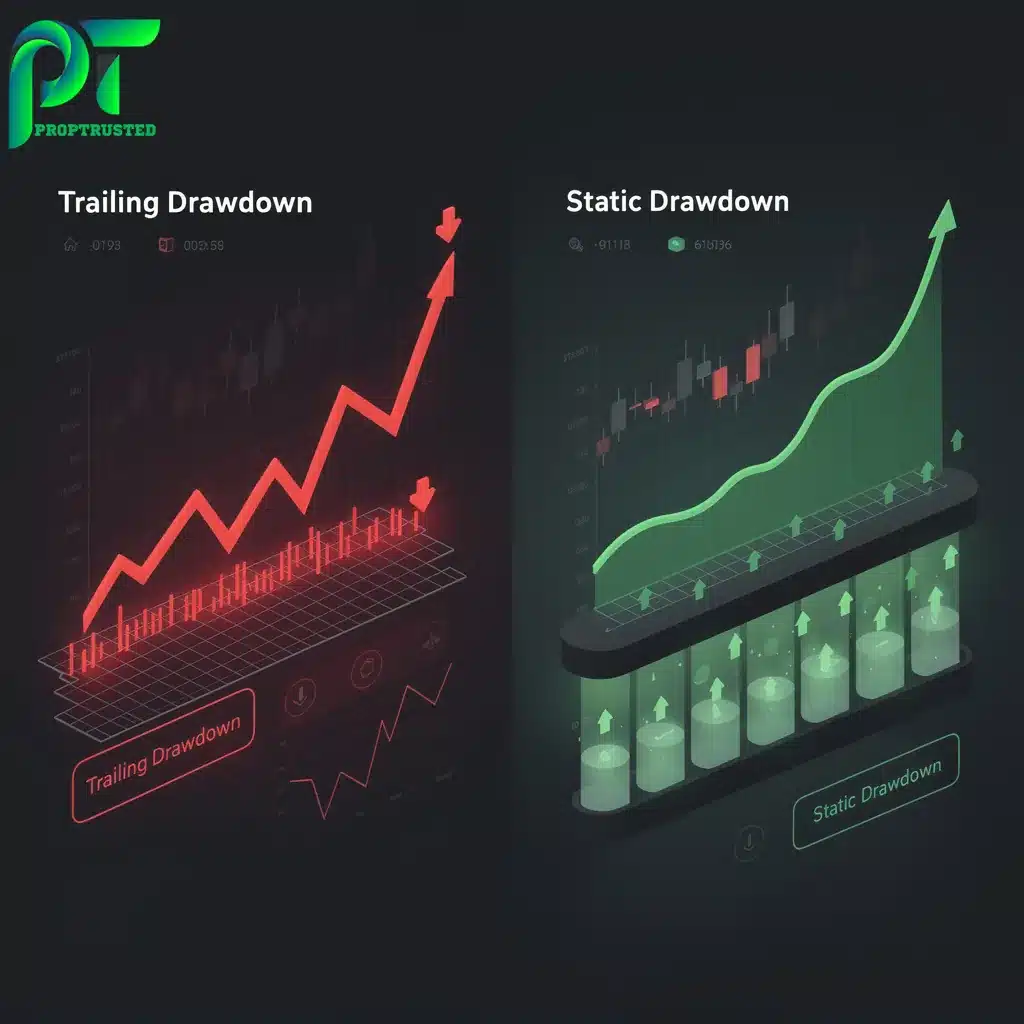
Definition Block: Trailing drawdown is a dynamic maximum loss limit that adjusts upward based on your account's highest equity peak (high-water mark). As unrealized profits increase your balance, the breach threshold rises proportionally, permanently locking in higher minimum balance requirements. The floor never moves down, meaning normal market pullbacks can trigger an account breach even if you are in overall profit.
Prop firms implement trailing drawdown through real-time equity monitoring systems that operate in three stages:
- High-Water Mark Detection: Every tick in your account equity is compared against the stored maximum value. Any new peak resets the calculation.
- Threshold Adjustment: The new breach level is calculated (e.g., Peak Equity minus 10%). This becomes your new absolute floor.
- Continuous Monitoring: The moment your equity (balance + open P&L) touches this new floor, the account is terminated instantly by the server.
Intraday vs. End of Day (EOD) Drawdown Explained
Not all trailing drawdown is equal. The calculation frequency separates a manageable system from an impossible one.
Intraday Trailing Drawdown (Maximum Lethality):
- Calculates high-water mark using live equity values updated every tick.
- Any momentary equity spike (news slippage, spread widening) permanently raises your drawdown floor.
- A Monte Carlo simulation of 10,000 trader accounts showed a massive 71% breach rate within 60 days under this model.
End of Day (EOD) Trailing Drawdown (Safer Variant):
- The floor only recalculates at the close of the trading session (e.g., 5:00 PM EST).
- Intraday unrealized fluctuations do not adjust the threshold—only the final equity snapshot matters.
- Reduces breach probability to roughly 43% over 60 days. It allows swing traders to survive intraday volatility, though it is still inferior to static models.
What is Static Drawdown? (The Trader's Ultimate Safety Net)
Why Professional Traders Prefer Static Limits

Definition Block: Static drawdown—also called fixed drawdown—is a permanent maximum loss limit calculated strictly from the initial account balance. The breach threshold never adjusts upward, regardless of how much profit you accumulate. A $100,000 account with a 10% static drawdown has a fixed floor at $90,000 from day one until the account is closed.
Static drawdown creates a floor beneath you. Trailing drawdown creates a rising floor that chases you. With a static model, a trader who grows their $100,000 account to $130,000 still has the original $90,000 floor. Their effective buffer has grown to $40,000.
A 2025 survey of prop trading firms managing institutional capital revealed that 97.5% use static drawdown for trader risk limits. Zero professional desks use intraday trailing drawdown.
Why? Because profitable trading requires tolerating unrealized variance. Static drawdown allows you to scale up lot sizes progressively, hold runners through multi-day pullbacks, and weather normal drawdown sequences without the fear of a mechanical trap snapping shut.
Trailing Drawdown vs Static Drawdown Prop Firms (The Ultimate Comparison)
| Criteria | Trailing Drawdown | Static Drawdown |
|---|---|---|
| Floor Movement | Rises dynamically based on unrealized equity peaks. | Fixed permanently at starting balance. |
| High-Water Mark | Every equity peak permanently raises minimum balance requirement. | No high-water mark mechanism. |
| Risk of Breach | High – Normal retracements trigger violations (68% of breaches near start balance). | Low – Buffer expands as account grows. |
| Psychological Stress | Extreme – Constant tick-watching; fear of letting profits run. | Minimal – Clear boundary; focus is on execution. |
| Holding Multi-Day Positions | Dangerous – Overnight gaps and pullbacks create compounding breach risk. | Safe – Positions can be held for weeks. |
| Scaling Strategies | Punished – Leaving partial runners creates trailing risk. | Enabled – Taking partial profits is standard practice. |
| Firm's Incentive Alignment | Adversarial – Firm profits from evaluation re-purchases via trailing failures. | Aligned – Firm profits from actual trader success. |
| Professional Standard | Never used institutionally – Retail trap. | Universal standard – 97.5% of institutional desks use this. |
Top Prop Firms with No Trailing Drawdown in 2026 (Verified List)
The mass closure of trailing-drawdown-only firms between 2023 and 2025, combined with trader education, has forced a structural pivot. The following are the best prop firms offering highly favorable drawdown rules, balance-based structures, and massive discounts for PropTrusted readers.
1. FundedNext (The Balance-Based Champion)
FundedNext has revolutionized the industry by offering a purely balance-based drawdown model. Unlike traditional trailing models that punish you for unrealized equity spikes, FundedNext calculates your drawdown based on your closed balance.
- The Edge: If you have an open trade floating in deep profit and it retraces, you are not penalized. Your drawdown is calculated logically.
- Best For: Swing traders and those who like to let winners run.
2. E8 Markets (Premium Tech, Fair Rules)
E8 Markets is heavily respected for its transparency and custom-built dashboard. While they have specific scaling and drawdown mechanics, they are completely transparent and offer highly favorable conditions for disciplined traders.
- The Edge: E8 provides one of the cleanest trading environments with flexible drawdown options on their specific challenges.
- Exclusive Offer: Get up to 30% OFF your E8 evaluation using our exclusive link.
3. Funding Pips (Rapid Scaling, Clear Drawdowns)
Funding Pips is designed for execution speed and straightforward rules. They have heavily aligned themselves with trader success, offering clear metrics without hidden trailing traps that catch you off guard.
- The Edge: Unmatched scaling plan and extremely competitive pricing.
- Exclusive Offer: Secure a 5% Discount on all Funding Pips challenges.
4. FTMO (The Gold Standard of Static/Clear Rules)
We cannot discuss fair drawdown models without mentioning FTMO. As the oldest and most reliable firm in the CFD space, FTMO's drawdown rules are crystal clear, static for the daily limit (calculated at midnight CE(S)T), and maximum loss is strictly fixed to the initial account balance.
- The Edge: 100% payout reliability and zero hidden trailing mechanics on equity peaks.
Strategic Trading: How to Survive a Trailing Drawdown (If You Must)
If you are currently locked into a trailing drawdown evaluation, these strategies are your mechanical reality for survival until you can migrate to a static-model firm.
1. Front-Load Your Buffer Before Scaling
Do not increase your lot size until your equity cushion above the current floor is at least 1.5x to 2x your typical trade risk. If your floor is $92,000 and balance is $96,000, you have a $4,000 buffer. Only trade sizes that allow you to take 5-8 losses within that specific buffer.
2. The 50% Profit Lock Rule
Under trailing drawdown, unrealized profits are a liability. Close 50-70% of any position that reaches 3-5% unrealized account growth (e.g., $3,000 profit on a $100K account). This converts floor-moving unrealized equity into a realized balance, preventing the trailing mechanism from locking in a high-water mark that you cannot defend if the trade retraces.
3. Hard Cap Your Daily Drawdown at 50% of the Firm's Limit
If the firm allows a 5% daily drawdown, set your personal hard limit at 2.5%. This preserves your overall trailing floor from single-session disasters. Use hard stop-losses server-side on every open position—no mental stops.
Frequently Asked Questions (FAQ)
What is the difference between trailing drawdown and static drawdown in prop trading?
Trailing drawdown is a dynamic loss limit that rises as your account equity (including open trades) reaches new highs, permanently locking in a higher floor. Static drawdown is a fixed limit set from the initial starting balance that never moves upward, regardless of how much profit you accumulate. Static drawdown allows your effective buffer to grow, while trailing shrinks it.
Does unrealized profit count against my trailing drawdown?
Yes, on intraday trailing drawdown models (which many firms use), unrealized open equity moves your high-water mark in real-time. A trade sitting at +$3,000 unrealized has already moved your floor up by $3,000. If that trade retraces to zero, you have permanently lost $3,000 of your safety buffer.
Is EOD (End of Day) trailing drawdown safer than intraday trailing?
Yes, but it is not a perfect solution. EOD trailing calculates your high-water mark only at the daily market close (e.g., 5:00 PM EST). This allows you to survive intraday volatility and spikes. However, your daily closing peaks will still permanently raise your breach threshold, meaning it is still vastly inferior to a pure Static Drawdown model.
Which prop firms use static or balance-based drawdown?
The industry is shifting rapidly. Firms like FundedNext utilize a highly favorable balance-based drawdown model, while FTMO offers a strict, clear maximum loss limit based on the initial balance. You can find our full list of verified fair-rule prop firms on PropTrusted.com.
Can I switch from trailing to static drawdown mid-evaluation?
No. Drawdown models are locked at the time of purchase. If you are struggling with a trailing drawdown challenge, the most cost-effective strategy is often to trade conservatively, request a payout if funded, and immediately migrate your capital to a firm offering static or balance-based drawdown.
Why do prop firms use trailing drawdown if it causes so many failures?
Retail prop firms use trailing drawdown because it mathematically increases the failure rate without appearing overly strict on paper. Higher failure rates generate more evaluation re-purchase fee revenue. Institutional and professional trading desks do not use trailing drawdown; they almost exclusively use static limits.
Published on PropTrusted.com — Your verified source for prop firm reviews, rule analysis, and funded trader resources.