
The ICT Prop Firm Strategy: Pass Any Evaluation Without Hitting Drawdown

You wake up at 3:47 AM EST to catch the London open. Your charts are pristine—Fair Value Gaps marked, Order Blocks highlighted, overnight liquidity pools mapped. You've been studying the SMC prop firm strategy for eighteen months. You know the theory cold.
London session hands you a clean sweep of the Asian range lows. Price rejects beautifully. Your stop sits 38 pips away because the last down candle was large and you "needed to give it room." You're trading a $100,000 challenge account, calculating a 2% risk because that's what retail trading taught you.
Then NFP drops. The spread on XAUUSD instantly blows out to 28 pips. Your floating equity—which was +$1,400 at the peak—reverses in 11 seconds. Eleven minutes later, you're staring at a $2,100 realized loss. Your prop firm's daily drawdown limit is $5,000, but a previous forced trade already put you down 3.2%.
At 11:03 AM, your challenge account is terminated.
You didn't fail because your ICT reads were wrong. Price eventually moved 280 pips in your predicted direction. You failed because you traded the right methodology with completely wrong risk architecture inside a prop firm framework. This blueprint translates raw ICT concepts directly into prop firm survival mechanics. If you apply this, passing a funded evaluation stops being a gamble and becomes a repeatable mathematical equation.
The "Drawdown Killer": Why Standard ICT Methods Fail in Prop Challenges
The ICT trading community obsesses over 1:10 risk-reward ratios. YouTube thumbnails scream about catching 200-pip runners from a single Order Block. This works brilliantly when you trade a personal account with infinite retry attempts. It becomes a death sentence in prop evaluations.
The Big R:R Trap
The conventional ICT approach prioritizes maximizing profit per trade over minimizing catastrophic risk. When you risk 1% to 2% per position hunting for a 1:5 R:R, a clean sequence of three consecutive losses burns up to 6% of your account. On most major firm evaluation accounts, a 5% daily drawdown limit means that sequence of losses will terminate your account before the winning trade ever triggers.
| Account Size | Typical Daily Drawdown Limit | Max Allowable Risk (Prop Firm Approach) | Standard Retail Risk (2%) | Evaluation Status After 2 Losses |
|---|---|---|---|---|
| $100,000 | $5,000 (5%) | $500 (0.5%) | $2,000 | Danger / Failed |
| $50,000 | $2,500 (5%) | $250 (0.5%) | $1,000 | Danger / Failed |
The firms don't care about your win rate. They care that you understand capital preservation within institutional risk parameters. A good Smart Money risk management strategy requires compressing your position sizes.
The ICT Prop Firm Blueprint: My 3-Step Strategy to Pass
Every prop firm evaluation passed using this methodology follows the same iron-clad framework: precision entries, compressed risk, and session-aligned execution.
Step 1 — The Liquidity Sweep Entry: Precision Over Frequency
Standard SMC teaching says: "Wait for liquidity to be swept, then enter on the retracement." Prop firm reality demands: Only trade a liquidity sweep prop trading setup with confirmed mitigation and sub-15-pip stop losses.
- Identifiable Liquidity Pool: Previous day high/low, Asian session range extremes, or equal highs/lows.
- Sweep Confirmation: Price decisively takes out the liquidity level and leaves a clear rejection wick.
- MSS & Mitigation: A Market Structure Shift (MSS) occurs leaving a Fair Value Gap (FVG). Enter when price returns to mitigate this imbalance.
The Prop Firm Position Sizing Formula:
Position Size = (Account Balance × 0.5%) ÷ (Stop Loss in Pips × Pip Value)
Example: $100,000 account × 0.005 = $500 risk. If your stop is 15 pips on EURUSD ($10/pip), your max lot size is 3.33 lots. Round down to 3.0 lots for safety.
Step 2 — Order Block Mitigation: Using OBs as Dynamic Stop-Loss Zones
The conventional approach treats Order Blocks as entry triggers. The prop firm approach treats Order Blocks as maximum allowable risk boundaries.
If an Order Block (OB) on the 1H timeframe requires a 40-pip stop loss to place your invalidation correctly below its wick, you must reject the trade. Prop firm survival requires rejecting "perfect" setups with oversized risk. You must drill down to the M5 or M15 timeframe to find refined OBs that allow you to place a structural stop loss of 10 to 20 pips max. This allows you to deploy your 0.5% risk budget effectively.
Step 3 — Session-Based Trading: Avoid Non-Volatile Dead Zones
Trading during low-volatility periods forces you into extended holding times and requires widened stop losses to survive chop. To pass a prop firm challenge with SMC, limit your execution exclusively to:
- London Open Kill Zone (02:00 – 05:00 EST): The highest-conviction session for Asian range liquidity sweeps.
- New York Open Kill Zone (07:00 – 10:00 EST): Focus on NY midnight open liquidity sweeps. Often requires slightly wider stops but offers massive directional displacement.
Selecting a Prop Firm That Respects ICT Logic

Not all prop firms are compatible with ICT methodology. Some impose evaluation rules that directly contradict institutional order flow principles, specifically regarding news trading and daily profit consistency.
1. The News Trading Trap
ICT concepts specifically target liquidity engineered around high-impact news (NFP, CPI, FOMC). Firms that completely prohibit trading ±5 minutes around news eliminate 60% of your highest-probability setups. You need firms that understand institutional flow.
How the best firms handle it in 2026:
- FundedNext: Places zero restrictions during the evaluation phase. On Funded accounts, you can still trade the news, but profits made specifically within a 10-minute window (±5 mins) of high-impact news are subject to a 40% profit share reduction. You won't breach; your payout is just adjusted.
- E8 Markets: Places zero restrictions during the evaluation phase. However, on Funded accounts, they enforce a strict 5-minute pre/post no-trade window around Tier 1 data.
2. No Consistency Rules on Evaluations
ICT strategies that catch major liquidity sweeps often produce 70% of the evaluation profit in 2 exceptional days. If a firm caps your maximum daily profit at 40%, your flawless execution fails the challenge. You must select firms with zero consistency rules during the evaluation phase. If you are looking for alternatives that support swing traders with generous drawdown limits, you can also explore Alpha Capital Group or City Traders Imperium. Alternatively, if you want to skip the challenge phase altogether, platforms like Goat Funded Trader provide direct funding models.
Managing Capital Like a Funded Trader (Not a Gambler)
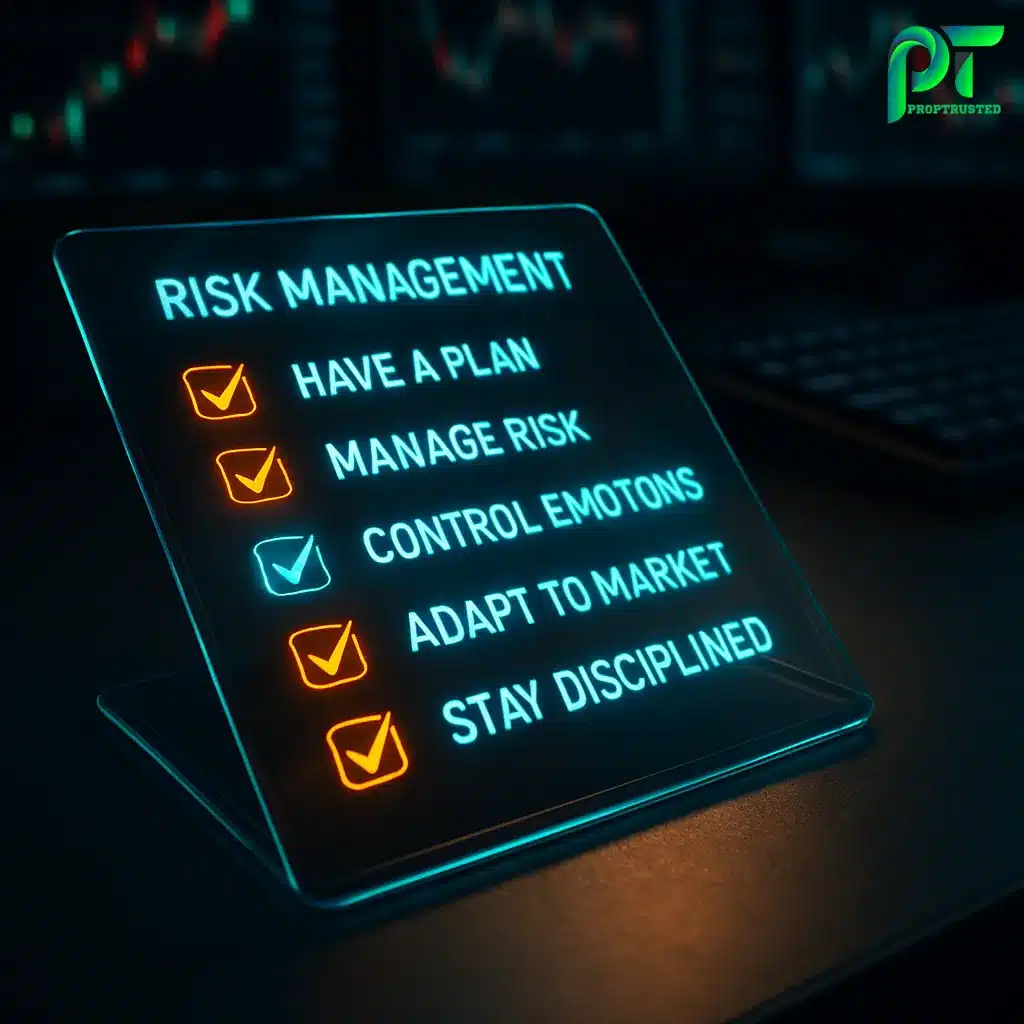
The difference between a retail gambler and a professional funded trader isn't market knowledge. It's operational discipline. I use this exact "Circuit Breaker" checklist to protect my ICT daily drawdown.
- Two consecutive losses in one session: Close the platform. You are done for the day. This prevents the emotional spiral into your max drawdown limit.
- Max Risk Per Trade: 0.5% (Standard) to 0.75% (A+ Setup). Never exceed 1% under any circumstance.
- Floating loss reaches 50% of your daily limit: Stop taking new entries. Manage open positions only.
- News Event drops in 10 minutes (Funded Accounts): If trading on E8, close positions to respect the blackout window. If on FundedNext, hold if your stop is safe, but be aware of the profit share adjustment.
Frequently Asked Questions (FAQ)
How do I calculate position size for a 0.5% drawdown in SMC?
Formula: (Account Balance × 0.005) ÷ (Stop Loss in Pips × Pip Value). For a $100K account, your risk is $500. If your Order Block stop loss is 15 pips on EURUSD ($10/pip), your max position is 3.33 lots. Always round down to 3 lots to account for potential slippage.
Can I trade news with an ICT strategy on a prop firm?
Yes, but only on firms that explicitly allow it. FundedNext and E8 Markets allow completely unrestricted news trading during the evaluation phases. On funded accounts, tactical awareness is required (FundedNext adjusts profit share ±5 mins, E8 restricts trading ±5 mins).
What is a liquidity sweep in the context of prop firm drawdown?
A liquidity sweep is when price temporarily breaks a visible high or low to trigger retail stop losses before reversing. In a prop firm context, this provides the tightest and most structurally logical stop loss placement, allowing you to maximize lot size while strictly adhering to a 0.5% risk limit.
Which prop firm is best for an ICT/SMC trader?
FundedNext (Stellar CFDs) is highly recommended due to the absence of consistency rules, unrestricted news trading on challenges, and static maximum drawdown models. E8 Markets is also a top-tier choice for its On-Demand payout structure.