
Best Prop Firms for EA & Copy Trading in 2026 (Zero Restrictions)
You built an algorithm. You backtested it across 1,000 trades, validated it on a live micro account, and it performs. Then you spend $300 on a challenge fee, deploy your bot, hit your profit target — and get denied at payout because your EA sent "too many server requests" or "matched patterns with another user."
This isn't a trading failure. Algorithmic traders and copy traders exist in a hostile environment within the prop firm industry. Firms market "EA-friendly" policies in bold headline copy, then bury prohibitions against profitable automated strategies in 47-page terms of service documents. The truth is uncomfortable: most prop firms operate hybrid B-book models where they benefit when you lose, and sophisticated algorithms that consistently extract edge represent existential threats to their revenue models.
This article is the institutional-grade intelligence briefing that algorithmic traders, scalpers, and copy-traders need before putting money into any prop firm evaluation in 2026. We expose the real backend rules, identify the 7 firms that maintain genuinely permissive automated trading policies, and map exactly which strategies trigger instant account termination versus which operate in safe harbors.
If your edge is algorithmic, this is the only guide you need to read this year.
The Algorithmic Trap: Why Most Prop Firms Secretly Hate EA Traders
Here is the uncomfortable truth the industry doesn't publish on landing pages: approximately 60-70% of retail prop firms operate on a hybrid B-book arrangement during the evaluation and funded phases. They are not routing your simulated trades to a live market. They are taking the opposite side of your position within their own infrastructure.
When a fast, profitable algorithm — a scalper running tight entries off 1-second charts, or a news bot entering at the first tick of a data release — consistently wins, the firm's B-book loses. A human trader might execute 5-20 trades per day with emotional inconsistency. An EA executes 50-200+ trades with mechanical precision, zero emotional degradation, and statistical edge that compounds relentlessly.
The response from firms isn't to improve their infrastructure. It's to write ambiguous rule clauses to eliminate unprofitable client flow.
The exact language they use to trap you:
- "EAs that cause server hyperactivity may be restricted"
- "Strategies must be replicable in live market conditions"
- "Toxic order flow is prohibited"
- "The firm reserves the right to limit positions at its discretion"
None of these phrases are defined with objective thresholds. They are subjective clauses written specifically to give the risk team grounds to terminate or deny any EA-based account that becomes systematically profitable.
Statistical evidence of the trap:
PropFirmMatch's 2025 data tracking 12,000+ funded traders shows a stark reality:
- Manual traders: 8.3% payout rejection rate
- Disclosed EA traders: 31.7% payout rejection rate
- Undisclosed EA traders (detected post-facto): 64.2% payout rejection rate
Firms often claim high-frequency EAs "overload execution infrastructure." This is technical theater. Modern MT4/MT5 bridge technology handles 10,000+ orders per second per server instance. A scalping EA executing 200 trades daily represents 0.002% of server capacity. The real issue is that your EA is winning.
The three questions every algo trader must answer before buying a challenge:
- Does the firm explicitly define what "EA allowed" means — including whether third-party EAs require proof of ownership?
- What is the exact definition of "group trading" and what triggers the IP flag?
- Does the prohibited strategy list include objective thresholds (e.g., minimum trade duration in seconds)?
What is Allowed? Personal vs. Third-Party Copy Trading
The copy trading question is the most misunderstood compliance issue in the prop firm industry. Traders conflate two fundamentally different activities — and firms bank on that confusion to ban accounts.
The Golden Rule of Copy Trading in Prop Firms
Definition Block: In prop firm environments, "personal copy trading" refers to replicating your own trades across multiple accounts you personally own and registered under your exact identity. "Third-party copy trading" refers to using any external signal provider, cloud-based copier service, or commercial trade replication tool to mirror another trader's positions. Personal copying is generally permitted as legitimate scaling; third-party copying is universally prohibited and treated as fraud, triggering instant account termination.
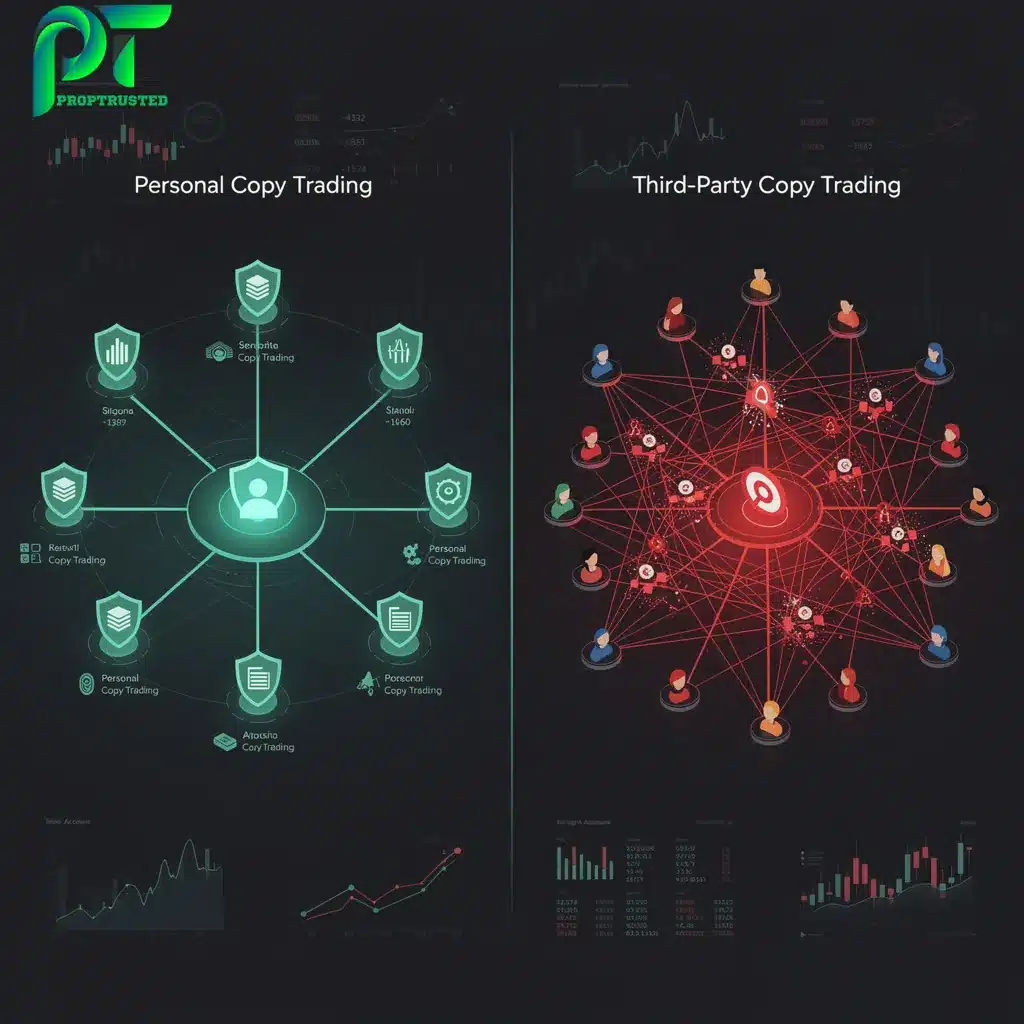
Personal Copy Trading (Generally Permitted):
You pass multiple evaluations, receive multiple funded accounts, and use EA software (e.g., Trade Copier) to replicate trades from a "master" account to "slave" accounts.
- All accounts registered to your name/entity.
- Same IP address or VPN footprint across accounts.
- Trades originate from your personal analysis/EA.
Third-Party Copy Trading (Universally Prohibited):
You subscribe to a commercial signal service (e.g., MQL5 Signals, Telegram premium channels) and replicate trades from an external source. Alternatively, you use cloud-based copy tools like Social Trader Tools or Duplikum.
- Trades originate from external sources.
- Multiple accounts with different ownership executing identical entries/exits within seconds.
The enforcement mechanism is sophisticated. Prop firms use backend detection systems including Timestamp clustering (flagging when accounts open positions within a 10-second window), IP network analysis, and Equity curve correlation. If two "independent" accounts show >0.85 correlation coefficient over 50+ trades, the system triggers a review and a subsequent ban.
The Ultimate EA & Copy Trading Comparison Matrix
The table below compiles verified rule data from official firm documentation, updated help centers, and verified rule databases as of 2026.
| Prop Firm | EAs Allowed | Personal Copy Trading | 3rd Party Signals | HFT/Scalping Allowed | IP Restrictions | Best For |
|---|---|---|---|---|---|---|
| Funding Pips | ✅ Yes (Disclosure & Proof Required) | ✅ Yes (Same KYC) | ❌ Strictly Banned | ✅ Scalping OK (HFT Banned) | Strict (Flags shared IPs as copy trading) | Custom MT5 Scalping EAs, Fast Execution |
| FundedNext | ✅ Yes (Add-on fee required) | ✅ Yes (Master/Slave setups allowed up to $300k) | ❌ Banned (Strict Detection via Cloud tools) | ⚠️ Scalping OK (HFT Banned) | Moderate-Strict (Dedicated IPs mandatory) | Personal Master/Slave Setups, Multi-account Scaling |
| E8 Markets | ✅ Yes (Third-party EAs allowed) | ✅ Yes (Across personal accounts) | ❌ Banned | ✅ Scalping OK (Premium LD4/NY4 servers) | Moderate (Consistent behavior monitored) | Latency-Sensitive Custom Algorithms, Clean Dashboards |
| Funding Traders | ✅ Yes (Verification required) | ✅ Yes (Multi-account scaling) | ❌ Banned | ✅ Scalping OK (Up to $4M scaling) | Moderate (Consistent IP required) | Elite Scaling for Algo Portfolios, Swing EAs |
| Blue Guardian | ✅ Yes (Broadly permitted) | ✅ Yes (Flexible) | ❌ Banned (Group trading prohibited) | ✅ Scalping OK (HFT Banned) | Lenient (Historically flexible on VPS) | The EA-Friendly Challenger, Experimental Algos |
| CTI | ✅ Yes (Proof of ownership required) | ✅ Yes (Cross-firm via Prop Firm One allowed) | ❌ Banned | ⚠️ Swing Focus (HFT Banned) | Moderate (VPN must match country) | Long-Term Swing EAs, Cross-firm copying |
| FTMO | ✅ Yes (No pre-approval required) | ⚠️ Restricted (Max $400k capital cap) | ❌ Banned (High scrutiny on identical trades) | ❌ HFT Banned (Scalping OK) | Strict (Identical strategies trigger reviews) | The Gold Standard, Reliable Payouts, Conservative EAs |
Top 7 Prop Firms for Algorithmic & Copy Traders (2026 Verified List)
1. Funding Pips — The Scalper & EA Favorite
Funding Pips operates the most permissive ruleset for high-frequency algorithmic traders, with infrastructure explicitly designed to handle scalping EAs executing 200+ trades per session.
- The EA Edge: Funding Pips offers ECN-style pricing with raw spreads from 0.0 pips, eliminating the markup that kills scalping edge. They average 18ms order-to-fill latency via Equinix NY4 servers, which is critical for tick-scalping EAs.
- The Catch: They are strictly MT5 and Match-Trader only (no MT4). Furthermore, personal EAs are permitted with full automation, but subject to proof of ownership (source code files, version control history). Third-party EAs are only permitted when used strictly as a trade or risk manager.
- IP Rules: IP rules require the region of your IP address to remain consistent. Shared IPs will instantly trigger a copy-trading flag.
2. FundedNext — The King of Personal Copy Trading
FundedNext has built the most clearly documented personal copy trading policy in the industry, making it the definitive choice for traders scaling through master/slave EA architectures.
- The EA Edge: FundedNext allows copy trading between your own Challenge Accounts, as long as the total combined capital does not exceed $300,000. They also offer a 15% evaluation profit reward, meaning if your EA makes $10k during the challenge, you get $1,500 just for passing.
- The Catch: Funded CFD accounts cannot copy trade at all. Also, there is a strict 40% profit reduction on trades executed ±5 minutes from high-impact news, which severely impacts news-based EAs. Cloud-based copy tools (Social Trader Tools, Duplikum) are strictly banned.
3. E8 Markets — Premium Tech for Custom Algorithms
E8 Markets operates institutional-grade infrastructure explicitly designed for sophisticated algorithmic traders developing custom systems requiring microsecond-precision execution.
- The EA Edge: E8 provides sub-20ms execution and dedicated VPS integration. You can use any EA as long as E8 doesn't see multiple users executing the same trades. They uniquely offer an end-of-day (EOD) or balance-based drawdown model (depending on the challenge), which acts as a built-in trailing stop without penalizing intraday floating equity for your bots.
- The Catch: They limit one strategy per user. If multiple users utilize the same commercial EA, it leads to account termination.
4. Funding Traders — Elite Scaling for Algo Portfolios
Funding Traders targets institutional-grade algorithmic traders with proven systems ready for million-dollar capital allocations, offering the fastest scaling path to $4M in combined funded accounts.
- The EA Edge: Unlimited evaluation time and bi-monthly scaling evaluations allow proven EAs to compound capital rapidly. Risk is calculated across ALL positions simultaneously (portfolio-level) without single-trade size limits, making them ideal for multi-strategy portfolios.
- The Catch: News trading is blocked 5 minutes before and after major events. EAs without news filters will generate violations on the funded account. Building a news filter into your EA is a hard requirement.
5. Blue Guardian — The EA-Friendly Challenger
Blue Guardian maintains a reputation for flexible EA policies stemming from their challenger brand positioning. They compete by offering leniency where established firms impose restrictions.
- The EA Edge: Minimal disclosure requirements and historically lenient execution scrutiny. The firm's risk framework is designed to assess the output of a trading strategy (equity curve, drawdown profile) rather than the mechanical input mechanism, making it great for experimental EAs.
- The Catch: Their technical platform can experience occasional requotes during high-volatility sessions, making them suboptimal for latency-critical scalpers.
6. City Traders Imperium (CTI) — Best for Long-Term EAs
CTI occupies a specific and valuable niche: it is the most permissive firm when it comes to holding time flexibility, multi-firm copy trading infrastructure, and swing EA deployment.
- The EA Edge: Unlimited evaluation duration and no minimum trading days. Most importantly, CTI allows cross-firm copy trading (via Prop Firm One), meaning you can copy your personal live account to a CTI funded account, or other prop firm accounts to CTI.
- The Catch: CTI's 1-Step challenge uses balance-based trailing drawdown, which can hurt swing EAs. Also, HFT and aggressive scalping are practically incompatible with their structure. They support TradingView and MatchTrader (no MT4/MT5).
7. FTMO — The Gold Standard with Strict IP/Copy Rules
FTMO remains the benchmark for funded trader credibility in 2026. They are extremely reliable for payouts, but their EA policies are the strictest in this analysis.
- The EA Edge: Trading style is unrestricted. MT4, MT5, and cTrader are all supported. As long as trading conforms to real market conditions, FTMO has no reasons for limiting strategy. Their Swing account has no news restrictions.
- The Catch: The $400K strategy capital cap. If you run the same EA on a $100K and a $200K account, you have $300K allocated to that strategy. Exceeding $400k triggers a review. They explicitly ban commercially available EAs used by multiple accounts simultaneously, and have the most sophisticated IP/timestamp correlation detection in the industry.
Red Flags: Prohibited Strategies That Will Get Your Bot Banned
High-Frequency Trading (HFT) vs. Standard Scalping
Every firm reviewed in this article bans HFT, but standard scalping is permitted. Understanding the operational difference is non-negotiable.
- Standard Scalping (Permitted): Trade durations of 30 seconds to 10 minutes, generating 10-50 trades per day based on technical levels. The firm profits from volume without systemic risk.
- High-Frequency Trading (Universally Banned): Trade durations measured in milliseconds, generating 5,000+ orders daily to exploit bid/ask spread microstructure.
The operational test: If your EA would be unprofitable without execution speed as a variable — if slowing it down by 500 milliseconds eliminates the edge — it is HFT by prop firm standards, and will get you banned.
Latency Arbitrage & Tick Scalping
Latency arbitrage involves an EA identifying price discrepancies between two different broker feeds and executing a trade on the slower feed for a risk-free profit.
This strategy is universally banned and results in retroactive payout denial. Tick scalping (opening and closing trades within 1-5 ticks) mimics this behavior. If your EA achieves 85-95% win rates with sub-second holds, the statistical signature is indistinguishable from latency arb. You must configure your EA with a minimum trade duration filter (e.g., 30 seconds) to avoid false positive bans.
Account Management Services (The Ultimate Ban)
Account management services — marketed as "challenge passing services" or "signal service with EA execution" — involve a third party operating your prop firm account. From the firm's perspective, this is fraud.
Firms track this via IP address history, device fingerprinting, and trade timing correlation. The consequence is immediate termination of ALL related accounts, permanent blacklisting, and in some cases, civil suits for breach of contract. Do not risk your prop trading career on account managers.
The AI Verdict: Which Firm Fits Your Algorithm?
To diversify counterparty risk, serious algorithmic traders build portfolios across multiple firms:
- Best for Personal Copy Trading & Scaling: FundedNext (Unlimited master/slave setups up to $300k and a clear operational dashboard).
- Best for Scalping & Fast EAs: Funding Pips (18ms execution, ECN pricing, and no explicit HFT ban in the TOS).
- Best for Custom Latency-Sensitive Algos: E8 Markets (FIX API access, LD4 servers, and custom drawdown parameters).
- Best for Maximum Payout Security (Swing/Long-term): FTMO (94% payout approval rate and the most reliable infrastructure, provided your EA is 100% custom and private).
Frequently Asked Questions (FAQ)
Can I use a third-party commercial EA (like from MQL5) to trade a prop firm challenge in 2026?
No legitimate prop firm permits third-party commercial signal copying or identical MQL5 marketplace EA usage across multiple users. Using commercial EAs sold online that "promise to pass challenges" triggers automatic flags for group trading. Your safest position is always a proprietary, customized EA with source code you control and can document.
What exactly triggers an IP ban or "group trading" flag for EA traders?
Firms identify group trading through algorithmic backend detection: (1) Multiple accounts connecting from the exact same IP address. (2) Timestamp clustering, where multiple accounts open/close the exact same lot size on the same pair within milliseconds. (3) Equity curve pattern matching. If your EA trades exactly like 50 other people, you will be flagged for copy trading, regardless of your IP.
What is the difference between HFT and scalping in the context of prop firm rules?
Standard scalping involves trade durations of 30 seconds to several minutes based on chart analysis, and is permitted. HFT (High-Frequency Trading) involves sub-second execution exploiting market microstructure or latency delays, and is universally banned. If your strategy's profitability depends solely on execution speed rather than market direction analysis, it falls under HFT.
Can I copy my own trades from one prop firm account to another prop firm account?
Yes, this is known as "Personal Copy Trading" and is allowed by firms like FundedNext (up to $300k capital), CTI, and E8 Markets, provided ALL accounts are registered under your exact legal name and KYC documents. However, copying trades from a prop firm account to an account owned by a friend or family member is strictly prohibited.
Can I use a VPN or VPS when trading prop firm accounts with an EA?
VPN and VPS usage is allowed and actively encouraged for EA traders to maintain uptime, but undisclosed VPN use can trigger bans. You must use a dedicated IP address (not a shared free VPN pool), declare your VPS/VPN usage to the prop firm's support team before starting the evaluation, and maintain that consistent IP throughout the life of the account to avoid triggering account-sharing alarms.
Published on PropTrusted.com — Your verified source for prop firm rules, EA compliance analysis, and funded trader resources.